Do you translate documents?
No. The office commissions the translator's affidavit. The translation itself has to come from an independent translator.
Mississauga notary guide
Sworn translator affidavits for IRCC, WES, ICAS, and court filings, including who can translate and what the notary does.
Unit #208, 1965 Britannia Rd, Mississauga, ON L5M 4Y4 — open the office in Google Maps
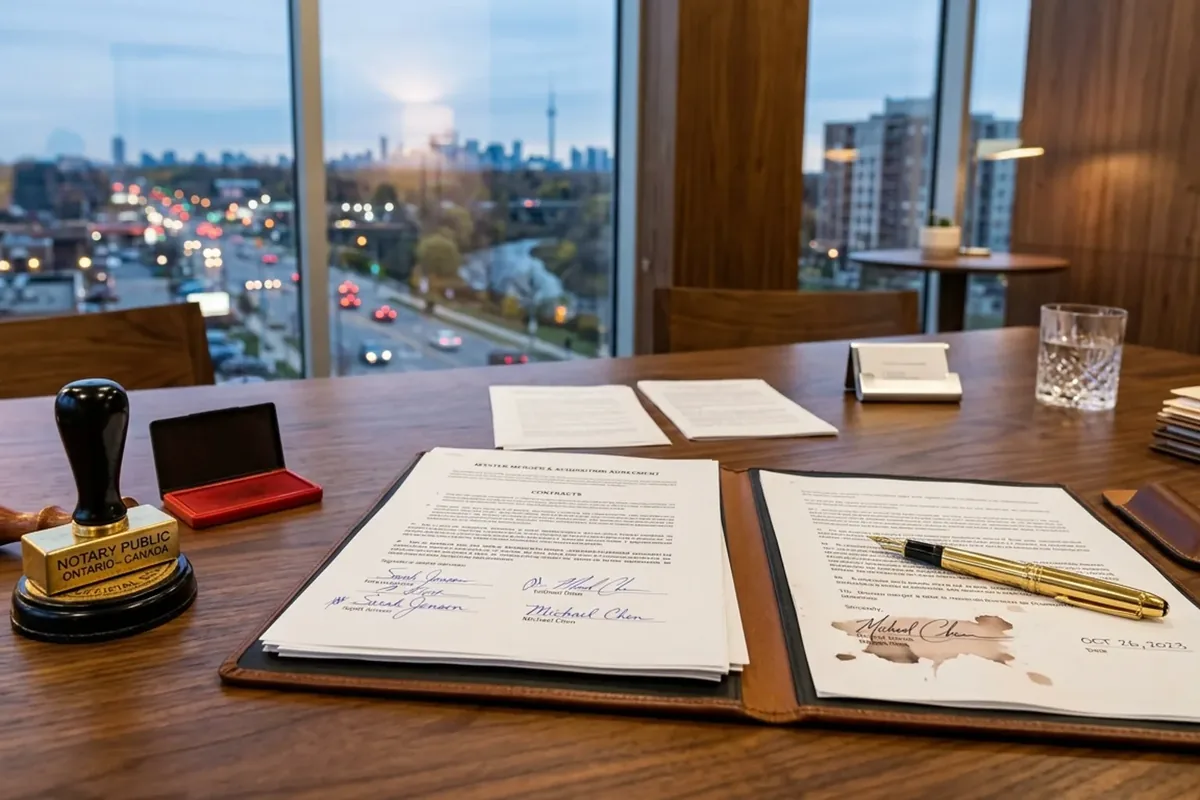
GTA Notary Public at Unit #208, 1965 Britannia Rd, Mississauga. Free visitor parking on site.
An **affidavit of translation is the sworn statement a translator signs to certify that a translation is complete and accurate. In Canada the document is usually called an Affidavit of Accuracy**, and it has to be sworn in front of a notary public or a commissioner for oaths. The translation alone is not a certified translation: it is the combination of the translation plus the sworn affidavit that IRCC, credential assessors, and courts accept. The notary does not translate, review the language, or judge the accuracy; the translator swears to that, and the notary administers the oath.
The translator must be able to swear that the translation is accurate, which means they need command of both languages and must be independent of the applicant. IRCC and most credential bodies do not accept a translation done by the applicant, the applicant's spouse, or a close family member, because the person swearing the affidavit would be vouching for their own work. Professional translation services normally prepare the affidavit as part of the job; if they did not, ask them for it before you book the notary appointment.
The translator brings the translation, the unsigned affidavit, and their government photo ID. The applicant does not need to be present, since the translator is the person swearing the statement.
The notary verifies the translator's identity and checks that the affidavit names the same person and the same document.
The translator swears or affirms that the translation is true, complete, and accurate, and signs in the notary's presence.
The notary completes the jurat with the date and location, applies the office seal, and signs. The certified translation package is ready to submit straight away.
Translation packages often need certified true copies of the original document as well, because the receiving office compares the translation against a certified copy rather than the original. Bring the original document so the office can certify the copy in the same visit; a certified true copy starts at CAD $35 for the first document and $20 for each additional one.
Commissioning an affidavit of translation starts at CAD $35 for the first affidavit and $20 for each related additional affidavit. Translation fees are charged by the translation service and are separate from the notary fee. Book online for the next business day, or call (905) 267-4725 for same-day availability. The office is at Unit #208, 1965 Britannia Rd, Mississauga, open Monday to Friday, 9:30 AM to 6:00 PM, with free visitor parking.
No. The office commissions the translator's affidavit. The translation itself has to come from an independent translator.
Usually not. IRCC and most credential assessment bodies require a translator who is independent of the applicant and not a close family member.
Yes. The affidavit is sworn, so the translator must be present to sign it. If a remote arrangement is unavoidable, call the office before booking.
CAD $35 for the first affidavit and $20 for each additional one in the same appointment. The translation fees themselves are separate and paid to the translator.
The affidavit must be sworn in front of the notary here, so the translator has to attend in person. If the translator is abroad, ask the recipient whether a declaration made before a notary in that country is acceptable.
Book online for the next business day or call (905) 267-4725 for urgent and same-day appointment guidance.